
Treatment course6 min read
Non-surgical treatment and physiotherapy in thoracic disc herniation
The treatment decision in thoracic disc herniation divides sharply according to whether the picture affects a nerve root or the spinal cord. Without neurological findings, the conservative approach is the first option and usually sufficient.
The acute phase
The first target is identifying and temporarily limiting the movements that trigger pain. Trunk rotation and deep forward bending are reduced in this phase.
Complete rest is not advised. Staying mobile within pain limits prevents rapid weakening of the back muscles and shortens recovery.
Breathing work begins early. Shallow breathing adopted because of pain restricts rib movement and worsens the picture.
Rib and thoracic mechanics
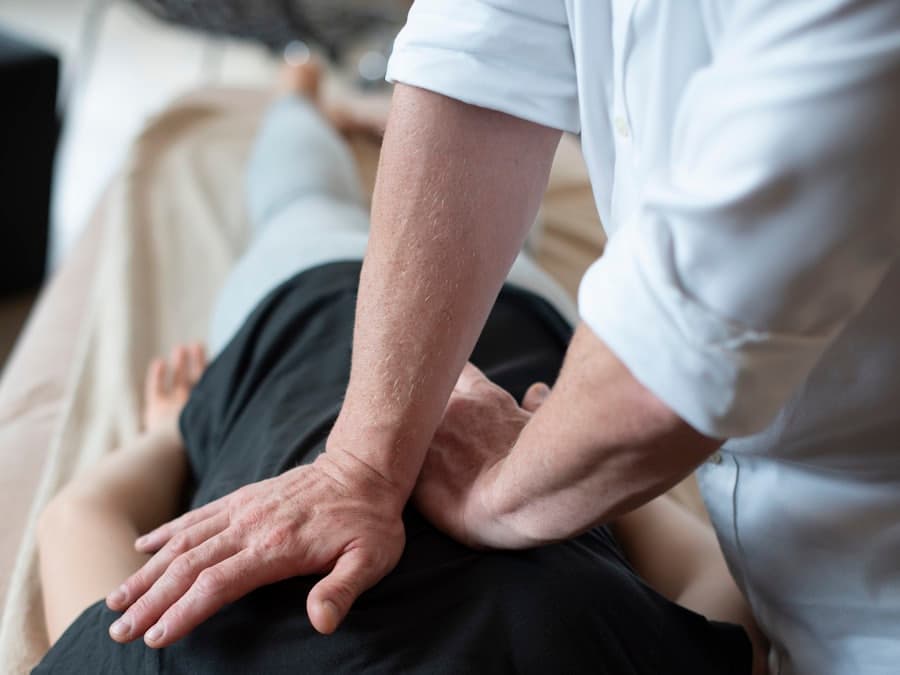
Rib joint mobility is assessed and restricted segments opened with mobilisation. In the upper back, disc and rib mechanics cannot be separated.
Thoracic extension and rotation range is increased. Movement concentrating at a single level loads the disc at that segment more.
Controlled mobilisation is preferred over high-velocity manipulation here, with technique selected after neurological assessment.
Strengthening and timeline
The back extensors and scapular stabilisers are progressively strengthened. As these muscles carry the trunk, load on the disc falls.
Endurance training of the deep trunk muscles is added. Load distributed evenly along the spine prevents overloading at a single segment.
A clear reduction in symptoms is usually seen within six to twelve weeks. If there is no progress, or neurological findings appear, imaging and surgical assessment arise.
Key points
- Without neurological findings, conservative treatment is the first option.
- Movement within pain limits is advised over complete rest in the acute phase.
- Shallow breathing from pain restricts rib movement.
- Disc and rib mechanics cannot be separated in the upper back.
- Clear improvement is usually seen within six to twelve weeks.
Frequently asked questions
Is surgery needed?
Rarely. Surgery arises where there are signs of cord compression or progressive neurological loss unresponsive to conservative treatment. Most thoracic herniations never reach that threshold.
Is massage helpful?
It can relieve accompanying muscle tension. It has no effect on the disc itself and does not replace the programme.
When can I return to sport?
Return is gradual once full pain-free range is achieved and trunk endurance is confirmed by measurement. Rotation and heavy lifting are added last.
Related articles
- Diagnosis and symptoms· 6 min readWhat is a thoracic disc herniation and what are its symptoms?
- Exercise· 6 min readExercise in thoracic disc herniation: breathing, mobility and endurance
- Treatment decision· 6 min readWhich upper back pain symptoms require urgent assessment?
- Daily living· 6 min readDaily life with thoracic herniation: lifting, sitting and breathing
Other topics in the same region
- Diagnosis and symptoms· 6 min readWhat is scoliosis and how is it noticed?
- Diagnosis and symptoms· 6 min readWhat is kyphosis? Is a hunched back the same as poor posture?
- Diagnosis and symptoms· 6 min readLocking in the upper back and pain on breathing: a facet joint problem
- Diagnosis and symptoms· 6 min readBurning between the shoulder blades: cause and meaning
Articles of a similar kind
- Treatment course· 7 min readNon-surgical treatment for a lumbar disc herniation: how the process works
- Treatment course· 6 min readNon-surgical cervical herniation treatment: stages and timeline
- Treatment course· 6 min readTreating cervical flattening: the target is endurance, not the angle
- Treatment course· 6 min readScoliosis treatment: exercise, bracing and the monitoring decision
This content is for information only and does not replace medical diagnosis or treatment. Response to treatment varies between individuals. Please consult a healthcare professional about your symptoms.