
Exercise6 min read
Exercise in lumbar stenosis: why direction matters
Exercise selection in lumbar stenosis differs from other back problems. What matters is not only which muscle works but the direction the back is held in, because direction directly changes canal width.
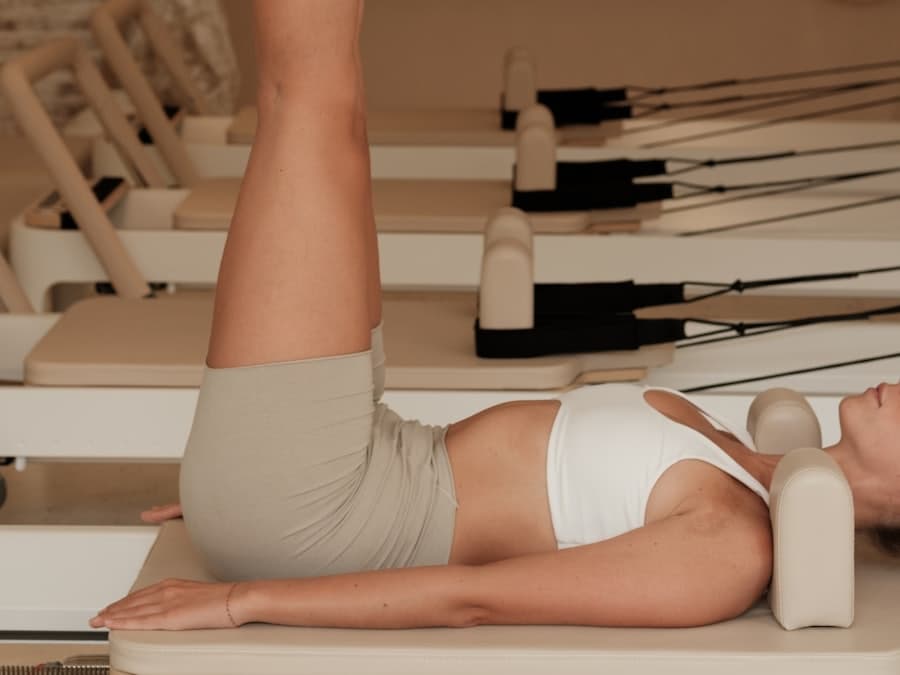
Flexion-based work
Drawing the knees to the chest while supine is the simplest and best-tolerated movement that widens the canal. Hold thirty seconds, five repetitions.
Seated forward bending makes the same effect available during time spent upright. It can also be used during walking breaks.
Arching the back upward in four-point kneeling widens the canal while maintaining lumbar mobility.
The walking programme
Interval walking is used: stop just before pain starts, sit briefly, then continue. Total distance increases gradually this way.
Pushing a shopping trolley or pram gives practical assistance. The forward-flexed position markedly extends distance.
A stationary bike maintains fitness while walking tolerance is low. The forward-leaning position is an advantage here and duration is usually far better tolerated.
What to avoid
Exercises requiring back extension narrow the canal and increase symptoms. Prone trunk lifts are not preferred here.
Standing still for long periods can be harder to tolerate than walking. Where standing is unavoidable, raising one foot flexes the back slightly and brings relief.
Reaching overhead extends the back. That position is avoided, using a step stool for high shelves.
Key points
- Bending forward widens the canal; extending narrows it.
- Drawing the knees to the chest is the best-tolerated movement.
- Interval walking progressively increases total distance.
- Standing still can be harder to tolerate than walking.
- Raising one foot while standing brings relief.
Frequently asked questions
Is swimming suitable?
Freestyle and pool walking are usually well tolerated. Breaststroke extends the back and may need limiting.
Can I do pilates?
Yes with appropriate adaptations. Movements involving back extension are removed or adapted to neutral; the trunk strengthening component is beneficial here.
How long until distance increases?
A measurable increase is expected within six to twelve weeks on a regular programme. Distance is recorded weekly to track it.
Related articles
- Diagnosis and symptoms· 6 min readLumbar spinal stenosis: leg pain that increases with walking
- Treatment course· 6 min readNon-surgical treatment of lumbar spinal stenosis
- Daily living· 6 min readDaily life with lumbar stenosis: practical solutions
- Treatment decision· 6 min readLeg pain when walking: stenosis or vascular?
Other topics in the same region
- Diagnosis and symptoms· 6 min readLumbar disc herniation symptoms: which pain points to a disc?
- Diagnosis and symptoms· 6 min readWhat is lumbar flattening and what does it mean on an X-ray?
- Diagnosis and symptoms· 6 min readIs back pain radiating to the buttock always a herniation?
- Diagnosis and symptoms· 6 min readWhat is degenerative disc disease, and why is the name misleading?
Articles of a similar kind
- Exercise· 7 min readDisc herniation exercises: which help and which to avoid
- Exercise· 6 min readCervical herniation exercises: what is safe and what to avoid
- Exercise· 6 min readExercises for cervical flattening: what actually works
- Exercise· 6 min readScoliosis exercises: why one programme does not fit everyone
This content is for information only and does not replace medical diagnosis or treatment. Response to treatment varies between individuals. Please consult a healthcare professional about your symptoms.